 Sicily Mount Etna Tours
Etna Cable Car: How It Works and What It Costs
The Etna cable car is a two-stage lift on the south side of the volcano that carries you from Rifugio Sapienza at 1,920 m up to a mountain station at 2,500 m. A return ticket costs about $54 (EUR 50) and the ride takes only minutes, which makes it the fastest way to gain serious altitude on Etna. The catch is what happens at the top. From 2,500 m you can walk the marked trails on your own, but to go higher, towards the summit craters at about 3,000 m, regional law requires a certified guide, sold as a combo with a 4x4 bus for about $89 (EUR 82). This page explains how the lift works, what it really costs, when it closes and whether it beats a guided trek. If you want the wider picture, compare all Mount Etna tours in the catalog before you decide.
Quick answer Ride, cost, the guide rule at 2,900 m and when closures hit
The cable car links Rifugio Sapienza at 1,920 m with a station at 2,500 m. A return ticket costs about $54.00 (EUR 50). To continue towards the summit craters you must join a guided combo with a 4x4 bus, about $89.00 (EUR 82), because the law requires a certified guide above roughly 2,900 m. The lift closes at short notice when volcanic activity or wind rises, and in winter the upper leg runs as a snowcat instead of a bus.
Key takeaways
- A return ticket alone gets you to 2,500 m and free marked trails, not the craters.
- The guided combo to about 3,000 m costs about $89.00 (EUR 82) and is the cheapest legal way near the summit.
- See how it stacks up in the [full [Mount Etna tours comparison before booking.
The Short Answer
Yes, the Etna cable car is worth it if you want high-altitude views without committing to a full-day trek, and if you accept that a ticket alone stops at 2,500 m. The ride itself is short and functional, not a scenic gimmick. You gain nearly 600 vertical metres in minutes and step out onto bare lava terrain that feels like another planet compared with Catania, where a 28C afternoon can end as an 8C wind on the slopes at 2,000 m.
The honest framing is this. About $54 (EUR 50) buys the lift and access to marked self-guided trails around the 2,500 m station. About $89 (EUR 82) buys the combo that adds a 4x4 bus and a volcanological guide to about 3,000 m, which is where the craters come into view.
If you only buy the lift ticket expecting crater views, you will leave disappointed. If you know what each price gets you, the math works.
Book the guided option if craters matter to you. The listing for the Etna Summit Excursion to 3,000 Meters by Cable Car and 4x4 runs 4-5 hours and costs $63.73, which undercuts the walk-up combo while adding transfer logistics.
How the Cable Car Works
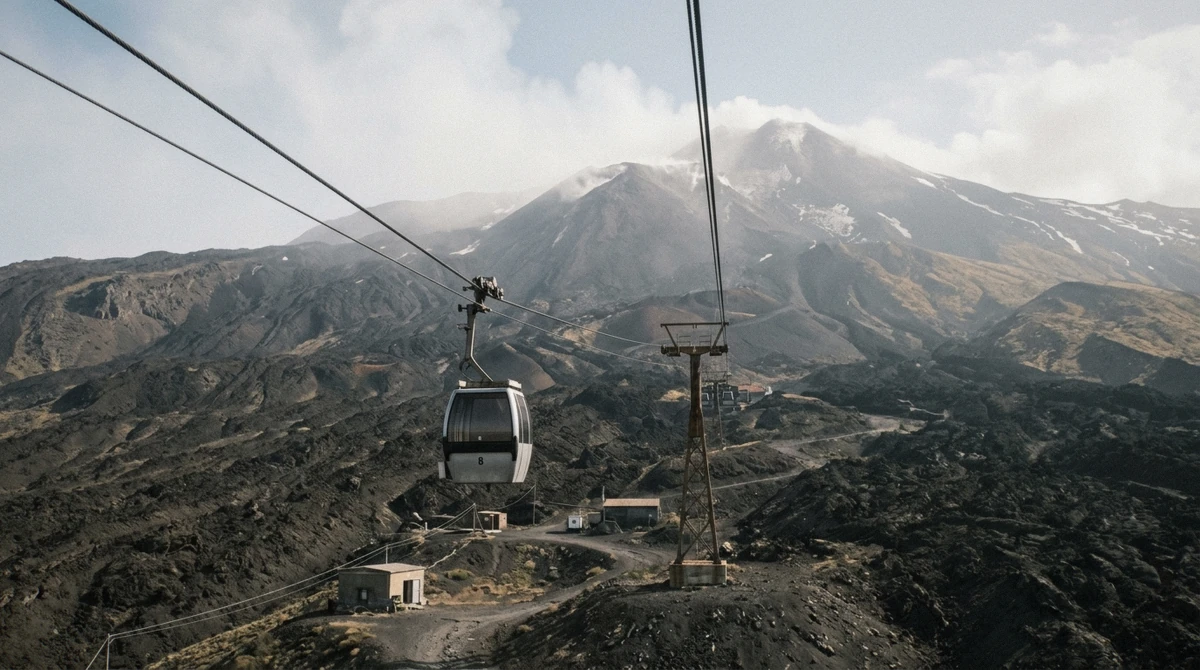
The lift starts at Rifugio Sapienza on Etna's south side, about 1,920 m above sea level, reached through the town of Nicolosi. It climbs to an upper station at 2,500 m. The cabins run continuously through opening hours, so you rarely wait long for a boarding slot outside peak summer queues.
You ride up, step off, and the upper station sits directly in the lava fields with marked trails radiating outward.
The second stage is not a second cable car. Above 2,500 m the operator runs a 4x4 bus in summer and a snowcat in winter, carrying visitors and guides further up the mountain. This is where the guide rule kicks in.
Sicilian regional law 28/1996 states that above roughly 2,900 m you may walk only with a certified alpine or volcanological guide. Below that line anyone can walk the marked routes, so a plain lift ticket buys real freedom, just not summit freedom.
Entry to the trails at Rifugio Sapienza is free. You pay for the cable car, the 4x4 buses and guides, nothing else. Trailhead access on the north side at Piano Provenzana, about 1,810 m, is also free, but there is no cable car there.
What It Costs: Return Ticket and the 3,000 m Combo
Two prices matter. The return lift ticket costs about EUR 50 (roughly $54). The combo, which adds the 4x4 bus and a volcanological guide to about 3,000 m, costs about EUR 82 (roughly $89).
Both figures are the operator's walk-up prices. Guided listings sold through the catalog can come in cheaper because transfers and guiding are bundled.
Here is the full cost picture side by side, including what each option legally allows.
| Option | What you get | Price | Guide required |
|---|---|---|---|
| Cable car return ticket | Lift from 1,920 m to 2,500 m and the marked self-guided trails | About $54 (EUR 50) return | No, below 2,900 m you walk freely |
| Cable car plus 4x4 and guide combo | Lift, then bus and volcanological guide to about 3,000 m near the summit craters | About $89 (EUR 82) | Yes, included in the price |
| Guided summit excursion listing | Cable car, 4x4 and guide as a bookable tour, 4-5 hours | $63.73 | Yes, included |
| Full-day summit hike listing | Guided trek to about 3,000 m on foot | Listed at checkout | Yes, included |
For most visitors the guided combo is the better spend. The extra $35 (EUR 32) over a plain return ticket is the difference between a windy viewpoint and standing near active craters with someone who can read the mountain. The Etna Summit Excursion to 3,000 Meters by Cable Car and 4x4 is the most direct way to buy that package. the official listings stay the final word
Is It Worth It? The Honest Math
Run the numbers against a guided trek. A full-day Mount Etna 3,000 m Summit Hike with Volcanology Guide gets you to the same altitude on foot, but it consumes an entire day and demands the fitness for hours of climbing on scree. The cable car combo gets you to about 3,000 m in a fraction of the time with most of the altitude gain mechanised.
Time-poor visitors win with the lift.
The counterargument is experience. Walking up through old lava flows teaches you the mountain in a way a bus ride cannot, and a full-day trek spreads the cost over many more hours of guiding. If Etna is the one big hike of your trip, the trek is the deeper experience.
If Etna shares the trip with Syracuse, Taormina beaches and a Catania food crawl, the cable car combo is the efficient choice.
There is also a middle path that skips the lift entirely. The Catania Morning Jeep Tour: Mount Etna and Lava Flow Caves costs $69.52 for 5.5 hours and explores lower slopes and lava caves by 4x4, no guide rule complications, no cable car queue. It will not reach 3,000 m, but it costs less than the walk-up combo and suits anyone happy below the 2,900 m line.
Our verdict, since the site reads and compares listings rather than running tours: the cable car is worth it as the transport stage of a guided combo, and worth it alone only if you are content with 2,500 m trails. For a fuller comparison of that trade-off, see Is Mount Etna Worth It? An Honest Verdict.
Closures: Wind, Activity and the Snowcat Season
The cable car is a fair-weather machine. It closes at short notice when volcanic activity rises, and Etna is one of the most monitored volcanoes on Earth, with the Catania section of INGV publishing activity updates that the operator acts on directly. Strong wind also stops the cabins.
Italy's civil protection keeps Etna at the yellow, lowest alert level, with day-to-day restrictions possible, so a closure can happen on a morning that looked clear at breakfast.
Season changes the upper leg too. In summer the section above 2,500 m runs as a 4x4 bus. In winter the same route runs as a snowcat, because snow covers the track.
The lift itself operates year round in principle, but winter weather closures are more frequent and the experience at 2,500 m becomes a snow affair rather than a lava one. Check the operator's status the evening before, since forecast reliability drops beyond about three days.
Never build a single-day itinerary where the cable car is the irreplaceable piece. Have a fallback. The Etna Sunset Tour from Catania at $98.49 for 5-6 hours stays on lower slopes, or the From Catania: Mount Etna Trek, Lava Cave and Tasting Tour at $66 for 7 hours combines lower trails with a cave visit and a tasting.
Both run when the lift does not.
- Check the lift status the evening before, not the week before, because forecasts are unreliable beyond about three days.
- Look at the Rifugio Sapienza, Crateri Silvestri and Torre del Filosofo forecast points on the south side.
- Expect short-notice shutdowns whenever INGV reports raised activity, even at the yellow alert level.
- In winter assume snowcat service above 2,500 m and a higher chance the whole system is shut.
Cable Car or Guided Trek: Picking Your Route
Both routes end near 3,000 m with a certified volcanological guide, as the law demands above roughly 2,900 m. The difference is how much of the climb you do with your legs. The cable car combo mechanises the first 600 vertical metres and then drives most of the rest, leaving a short guided walk at the top.
The trek does it all on foot over a full day. Fitness, time and budget decide.
For the lift route, the Etna Summit Excursion to 3,000 Meters by Cable Car and 4x4 is the catalog's most direct match at $63.73 for 4-5 hours, rated 4.71 from 689 reviews. For the trek route, the Mount Etna 3,000 m Summit Hike with Volcanology Guide runs a full day with the price listed at checkout. Both put you at about 3,000 m with a guide who can explain the craters, the 9,200-year-old Valle del Bove collapse on the eastern flank and what the current activity means.
Time-crunched travellers should pick the lift. Hikers who want the journey to be the point should pick the trek. Anyone staying in Taormina without a car has a third option in the Mount Etna Half-Day Small-Group Tour from Taormina, $100.80 for 6 hours, rated 4.91 from 690 reviews, which handles the drive and lower-slope trails without touching the cable car at all.
Parking, Queues and the Morning Window
Rifugio Sapienza has paid parking, and in July and August it fills by late morning. Arriving before 9:30 am keeps both a parking space and the clear-sky window, since cloud often builds over the mountain as the day warms. The drive from Catania takes about 45 minutes to 1 hour via the SS385 through Nicolosi and then the winding park road.
From Taormina count about 1 hour 15 minutes on the A18.
Queues at the ticket office mirror the car park. In high summer the morning line for the lift can be long, and the combo groups with guides board on a schedule, so a 9:30 am arrival often means a lift ride by mid-morning and crater time before the afternoon haze. Public transport is thin: a seasonal bus between Catania and Rifugio Sapienza runs in the high season only, so a rental car or a tour is the dependable way up.
Driving times at a glance, so you can plan the morning window properly.
| Starting point | Drive to Rifugio Sapienza |
|---|---|
| Catania | About 45 minutes to 1 hour via SS385 and Nicolosi |
| Taormina | About 1 hour 15 minutes on the A18 |
| Messina | About 50 minutes to the Taormina exit, then as from Taormina |
| Syracuse | Roughly 1 hour added to the Catania times via the A18 beltway |
| Palermo | About 3 hours via the A19 |
For the full road picture from every base, see How to Get to Mount Etna: Routes, Roads and Bases. If Taormina is your base, Taormina to Mount Etna: Every Way Up the Volcano breaks down each option.
What You See at 2,500 m Without a Guide
A return ticket alone is not a wasted one. From the upper station at 2,500 m, marked trails are open to anyone, because the guide rule only starts above roughly 2,900 m. You walk on bare lava, pass craters of earlier eruptions and look down the slope towards the Catania plain.
On a clear day the summit craters are visible in the distance, steaming, and the scale of the mountain becomes obvious in a way no photo manages.
What you cannot do unguided is approach the active summit craters. That terrain, above the legal line and near the current activity, belongs to guided groups with certified volcanological guides. The view from 2,500 m is genuinely good, but it is a view.
The combo turns the view into a visit.
Dress for it regardless of ticket type. The temperature gap is real: 28C in Catania can meet an 8C wind on the slopes at 2,000 m, and the summit zone is colder again and almost always windy. The layer system in What to Wear on Mount Etna: The Layer System That Works covers it.
For choosing the right season, see When to Visit Mount Etna: Months, Snow and Clear Craters.
The 4x4 Bus and the Snowcat: How the Upper Leg Works
The cable car ends at 2,500 m, and everything above it moves on tracks. From late spring to autumn the upper service runs as 4x4 buses that grind up the ash slopes to about 2,800 m, where the guided walk to about 3,000 m begins. When snow takes the slopes, the same service runs on tracked vehicles, and the character of the day shifts from walk to expedition.
The upper leg is where the guide requirement bites. The 4x4 drop point sits near the 2,900-metre line, and everything beyond it, including the Barbagallo crater rim that gives the combo its destination, is certified-guide territory under the regional rule. Riding the cable car alone buys the view from the top station, not the craters.
Both legs stop for the same three reasons: wind, snow clearance and volcanic activity. The operator's own channels carry the running status, and a closed upper leg usually still leaves the cable car's 2,500 m station open, which is worth knowing before you write the day off.
With Kids and Older Travellers
The cable car itself is the most age-friendly lift in this catalog: no steps, a short ride, and a viewing platform at the top station that needs no walking beyond the platform. Families with small children use it as the summit experience, and the official combo's age and health warnings read at booking, because the 4x4 section and the thin air at 3,000 m are a real step up.
Older travellers rate the morning combination highly: ride up, platform, coffee at the station, ride down, and the whole thing stays optional at every step. The ground at the top station is gravel and ash, so the shoes-and-layer rule from the packing guides applies even to the ride-only version.
For anyone deciding between this and a walking day, the honest frame is cost versus altitude. The cable car spends money to save about two hours of scree, and the walking days spend the legs to save the money. The tours page on the summit excursion puts the combined day's true cost next to the alternatives.
Tickets, Queues and Paying on Site
Tickets sell at the Piazzale Rifugio Sapienza ticket office and through the operator's online booking, and the combo with the 4x4 and the guide runs on timed departures that can sell out on fine August mornings. Card payment works at the main office, but the mountain's smaller points of sale are the reason every guide repeats the cash advice.
Queues live at two points: the ticket window and the cable-car boarding line, and both peak between 10 am and noon. The listing's own booking flow, and the guided listings in this comparison that pre-purchase the ride, exist to cut exactly those two lines.
One honesty note belongs here: prices at the mountain move with the season and the operator's maintenance calendar, and the figures this site quotes are the ones current when the catalog was last read. The official site is the final word on the day, which is why the fees section links it directly.
The North Side Alternative: No Cable Car at All
Piano Provenzana, the north-side trailhead at about 1,810 m, has no cable car and a different contract with the volcano: guided walks through the 2002 eruption zone, gentler crater paths, and far fewer people. Travellers who arrive, see the queue at Sapienza, and drive around the mountain often end the day happier on the north side.
The trade is altitude. The north side's guided routes reach the summit zone from the other direction, but its self-guided walking stays lower and greener, through the birch woods the lava spared. For a first taste of the volcano with children, it is the quieter answer, and the driving guide covers the road around from both coasts.
When the Ride Shuts: Wind, Snow and the Volcano
Three forces close the cable car, and none of them negotiates. Wind stops the cabins when gusts at the stations pass the operating limit, snow closes the upper leg until the tracks are cleared, and rising volcanic activity closes the whole summit zone, cable car included, until the alert level drops. Each shutdown is announced on the operator's channels, usually the evening before, sometimes the same morning.
A shut cable car is a redirect, not a dead day. The Silvestri crater walks below the station run whenever the mountain allows, the north side sits an hour away with its own crater paths, and the free-cancellation window on the guided listings absorbs the swap. Travellers who pre-check the status page rarely meet a closed door in person.
Etna Cable Car Questions, Answered
Is an Etna cable car worth it?
In clear morning weather, yes: it replaces about two hours of climbing with a 10-minute ride to 2,500 m and the views from the top station are the volcano's best. When wind or volcanic activity rises it closes with little notice, so treat it as weather-dependent.
How much does the Etna cable car cost?
About EUR 50 return to the 2,500 m station, and about EUR 82 for the combo that adds the 4x4 bus and a volcanological guide to about 3,000 m. Children's fares and seasonal changes read on the official site.
Can you see the summit craters from the cable car?
The top station at 2,500 m looks up at the summit zone, but the craters themselves sit above the 2,900 m guide line: reaching them legally means the combo route or a guided trek.
Where do you park for the Etna cable car?
At the paid car parks of Rifugio Sapienza, about 45 minutes from Catania through Nicolosi. They fill by late morning in July and August, which is another argument for the early start.
How do I get to the Etna cable car from Taormina?
About 1 hour 15 minutes by car on the A18, or on a half-day tour from Taormina that includes transport. The cable car base sits above Nicolosi on the south side.
Does the cable car run all year?
The lower leg runs year-round weather permitting; the upper 4x4 bus swaps to a snowcat in winter, and both legs stop when wind, snow or volcanic activity closes the zone.